
REVIEW · NEW ZEALAND
Kaikoura: Whale Watching Cruise
Kaikoura’s whale watching is built around a remarkable fact: giant sperm whales live just offshore, where deep water comes close to the coast. That gives you a real chance to see the world’s largest toothed predator without spending a full day at sea. The whale is the star, but dolphins, fur seals, albatross, and the snow-covered Kaikoura ranges make the whole outing worthwhile.
I like the excellent wildlife commentary, which combines science with Māori knowledge, and I like the clean, spacious catamaran, with outdoor decks for photos and a comfortable cabin when the wind picks up. The main caution is simple: this is the open ocean. Rough water can make some people very seasick, and sightings are never guaranteed.
Key things to know before you book
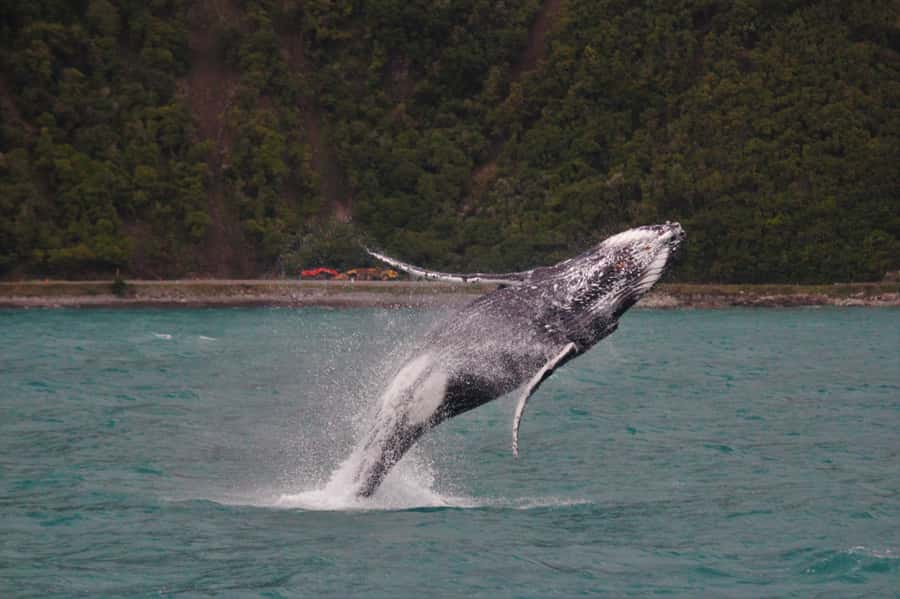
- Sperm whales are the main attraction: The crew uses experience and onboard tracking to locate whales that may spend long periods below the surface.
- Wildlife can be varied: You might also see dusky dolphins, fur seals, wandering albatross, blue penguins, orcas, pilot whales, and other seabirds.
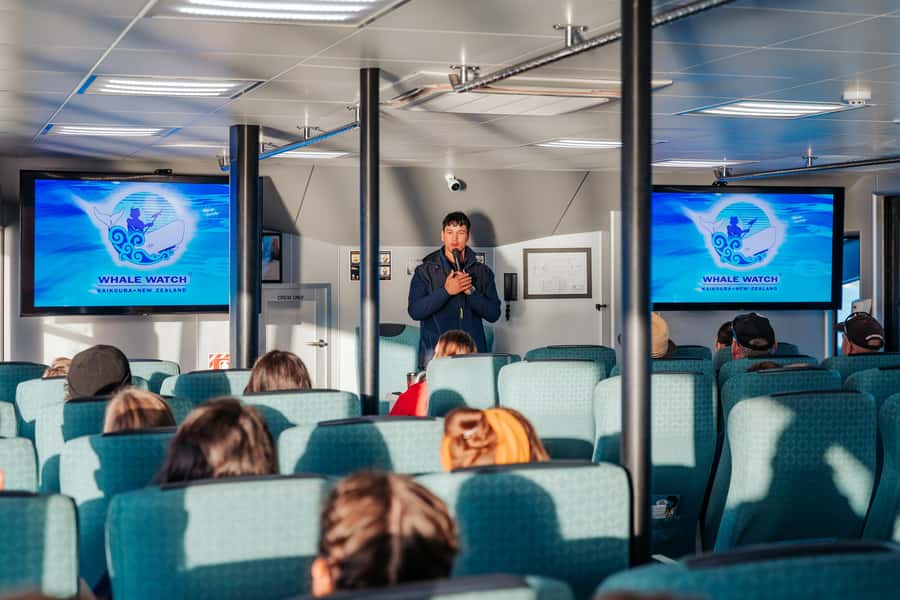
- The boat is made for viewing: You have large outdoor decks, comfortable indoor seating, air conditioning, and screens showing marine-life animations.
- Allow 3 hours 15 minutes: The cruise lasts just over two hours, but check-in, safety instructions, and the bus transfer to the boat add time.
- Sea conditions matter: Take motion-sickness precautions before arriving if you are prone to nausea. Tablets are available at the office.
- The operation has a strong local identity: Whale Watch Kaikōura is owned by the Ngāi Tahu iwi, and the commentary includes Māori connections to the sea.
Why Kaikoura is such a good place to look for whales
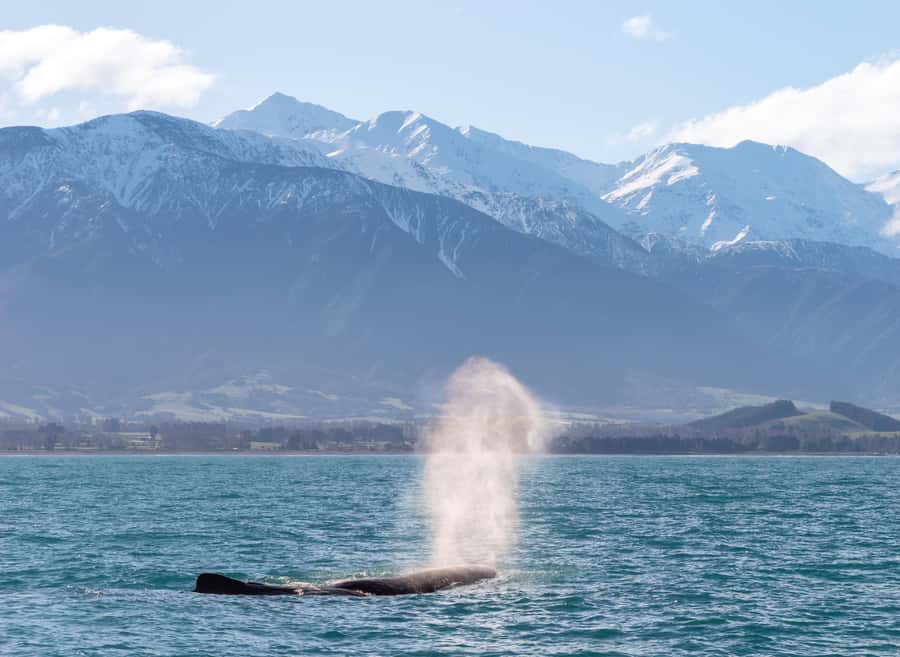
Kaikoura gives you a rare coastal setting for whale watching. The mountains rise behind town, while deep ocean water lies close offshore. That combination helps explain why sperm whales are found here and why the cruise does not need to travel endlessly before beginning the search.
You are not visiting an aquarium or a protected enclosure. The whales are free-ranging animals, and the crew has to locate them in their natural habitat. That makes a sighting feel earned. You may watch a whale breathe at the surface for several minutes, then see it raise its tail and disappear for a longer period.
The crew uses marine information and tracking equipment to help find the animals. One especially memorable feature is the sonar-based announcement that can alert the boat when a whale is below the surface. This gives you something useful to watch for instead of simply staring at an empty horizon.
I appreciate that the experience explains the setting rather than treating the whale as a quick photo stop. The commentary covers the animals, their behavior, and the sea around Kaikoura. It also brings in Māori knowledge and the connection between Ngāi Tahu and the whales. That adds a sense of place that a standard wildlife cruise can miss.
More Whale Watching Trips in New Zealand:
- Whale Watching in Kaikoura by Boat
★ 4.5 · 2,906 reviews - Auckland: Whale and Dolphin Watching Half-Day Eco Cruise
★ 4.5 · 1,072 reviews - Auckland: Tikapa Moana Whales, Dolphins and Islands Cruise
★ 3.9 · 292 reviews
Check-in, transfer, and the first look at the coast
You begin at the Whale Watch Kaikōura office, not directly at the vessel. Allow time for check-in, the safety briefing, and the short bus transfer to the port. The full experience is listed as 210 minutes, so do not plan another tight activity immediately afterward.
The transfer is useful because it keeps the starting point organized and separates town check-in from the boat departure. Staff handle the movement between the office and the vessel, and the process is designed to keep the group together.
Once onboard, you can settle into the cabin or head outside. The boat has comfortable indoor seats, air conditioning, plasma screens, and award-winning animations about marine life. I see this as more than a backup plan. If the sea is rough or the wind is cold, the indoor area gives you a place to recover while still following the presentation.
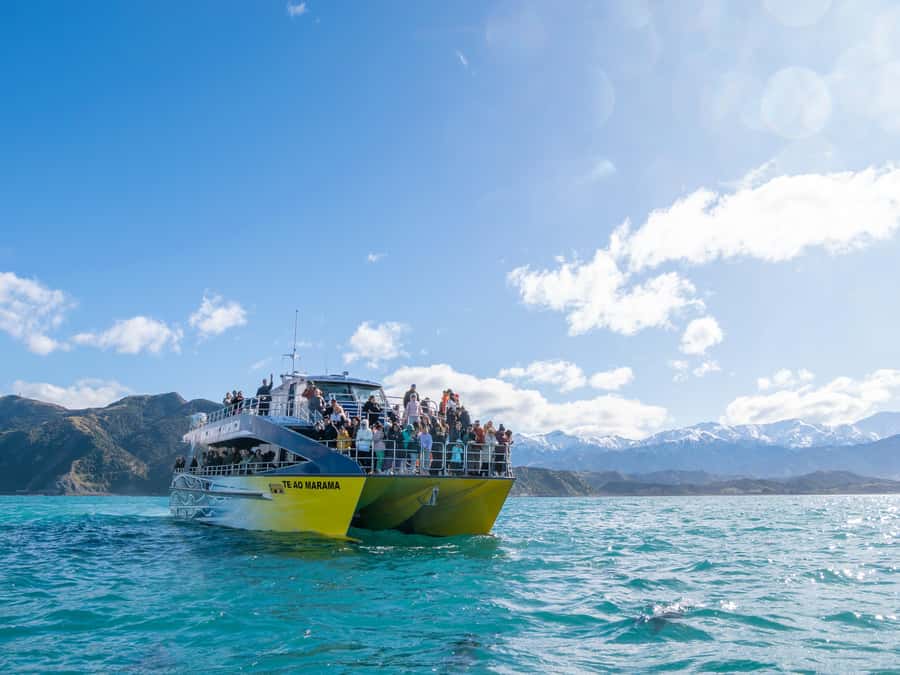
The outdoor decks are important because whale watching depends on sightlines. You want room to move from one side of the boat to the other, especially when a whale surfaces unexpectedly. The vessel is designed to carry more people than are normally placed aboard, so the group is kept below full capacity. That should give you a less cramped experience than a fully loaded boat.
Finding the sperm whale
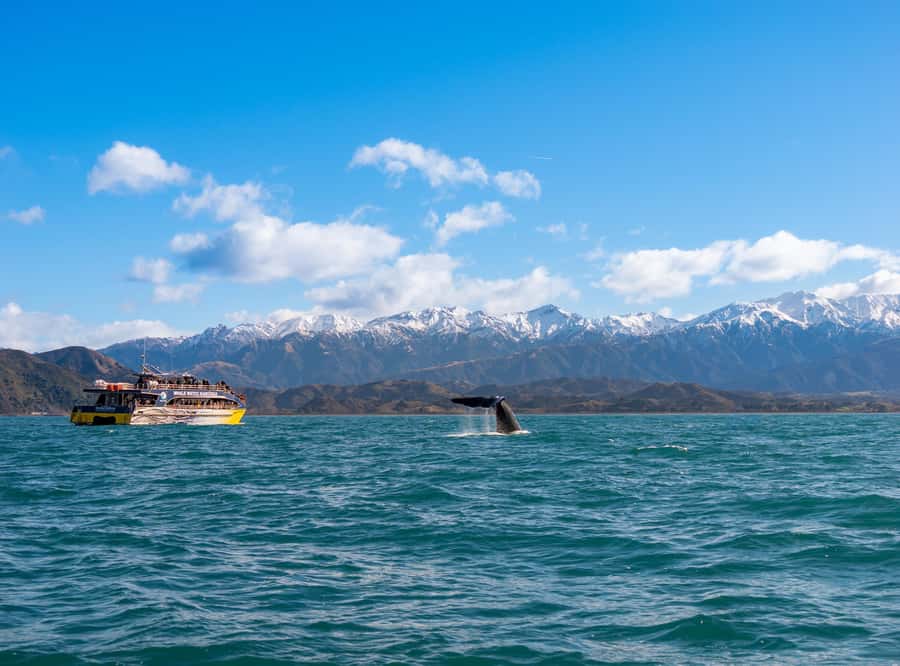
The central part of the cruise is the search. The crew takes the boat to likely whale locations, listens for signs below the surface, and watches for the telltale blow at the waterline. You may stop more than once before finding an animal.
This is not a ride where the main event happens on a fixed schedule. Some outings produce several whale sightings. Others may bring a single whale that appears briefly. One outing recorded two separate sperm whales, while another had five whale sightings. At other times, the animals stayed farther away, and one trip did not find a whale at all.
That uncertainty is worth understanding before you pay $104. You are paying for expert searching, a well-equipped vessel, interpretation, and access to a remarkable marine habitat, not a guaranteed performance. Whale Watch Kaikōura has also offered a substantial partial refund when no whale was found, but you should treat that as an operator response noted in one experience, not as a promise included in the booking information.
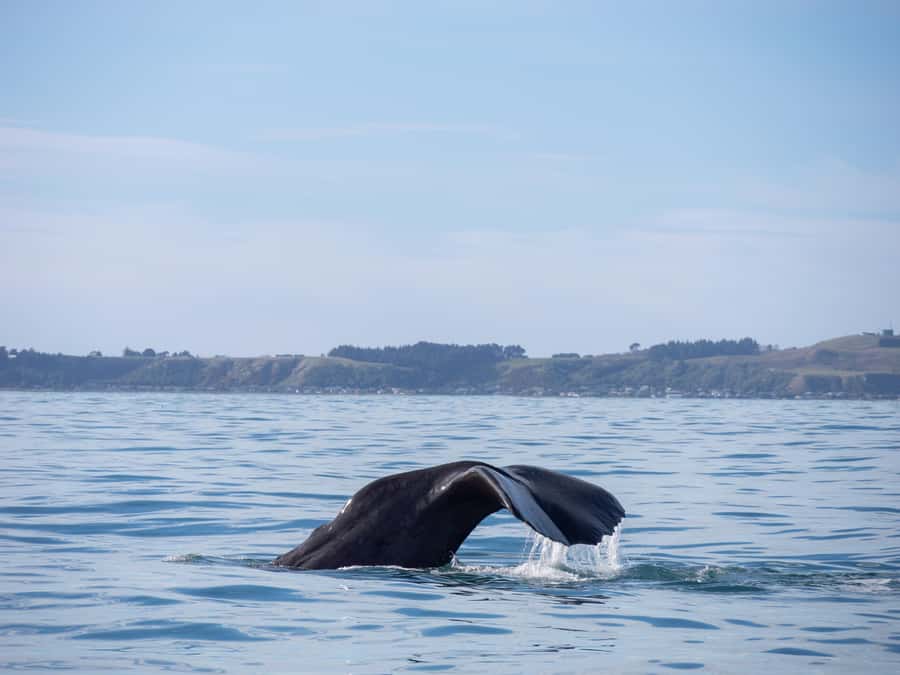
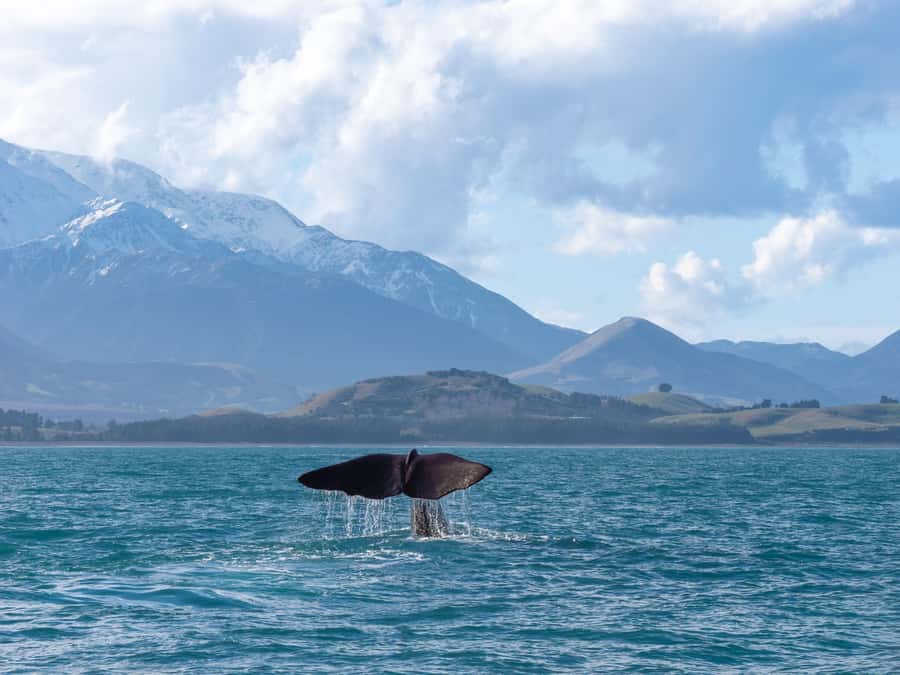
When the crew spots a whale, the mood changes quickly. You may see it breathing at the surface for around ten minutes. Then the guide warns you that it is preparing to submerge, giving you a chance to watch for the classic tail display. That warning matters because the best moment can last only a few seconds.
The tail is often a better memory than a close-up photograph. The boat can be near enough for a clear view, but the animal may still be farther away than you expect. I would bring a camera, then put it down often. Whale watching rewards patience more than constant filming.
Dolphins, seals, and birds add variety
The whale may be the reason you book, but the supporting wildlife can turn a good trip into a terrific one. Several outings encountered large groups of dusky dolphins, sometimes numbering around 100 or even 300 animals. They may leap, travel beside the boat, and create the most active part of the cruise.
Dolphins are also less predictable than whales. You may see them for 15 to 20 minutes, or you may not see them at all. Still, a lively pod can make the ride out feel like part of the experience rather than dead time between whale stops.
Fur seals are another regular possibility, often seen close to the vessel. They are a good reminder that the cruise is not only about one species. Seabirds can be equally rewarding for anyone who enjoys wildlife identification. Wandering albatross have been seen, along with different albatross species and Cape petrels.
Other sightings have included blue penguins, orcas, pilot whales, humpback whales, sharks, and rare dolphin species. None should be treated as standard inclusions. Think of them as possible bonuses that depend on the day, the season, and what is moving through the area.
I like this mix because it gives you several ways to have a successful outing. If the sperm whale surfaces at a distance, a pod of dolphins or an albatross gliding past can still make the cruise memorable. The crew’s commentary helps you understand what you are seeing rather than reducing the wildlife to a list of names.
A few more boat days around New Zealand worth a look
- Waitomo: Glowworm Caves Guided Tour by Boat
★ 4.5 · 4,908 reviews - Premium Milford Sound Small Group Tour & Cruise from Queenstown
★ 5.0 · 3,001 reviews - Cruise Milford NZ Small Boutique Cruise Experience
★ 5.0 · 2,930 reviews - Queenstown: Walter Peak Gourmet BBQ & Lake Whakatipu Cruise
★ 4.8 · 2,713 reviews
What the catamaran feels like at sea
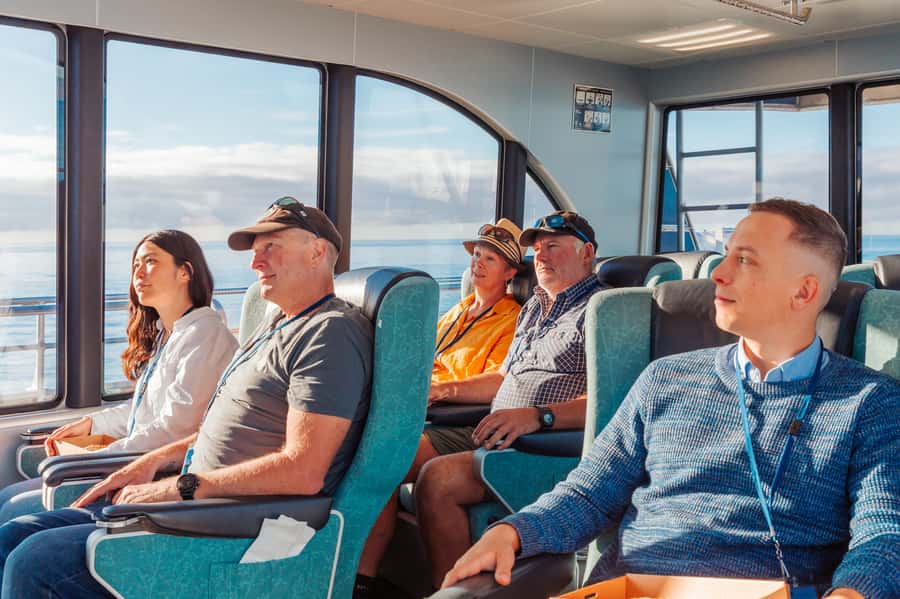
The catamaran is modern, spacious, and built with whale watching in mind. You can use the open decks for views, then return inside to watch animations and listen to the presentation. The engines are designed to minimize underwater noise, and the vessel has nonpolluting toilets.
Several things here matter in practical terms. A clean boat with enough space makes it easier to move around when wildlife appears. A powerful vessel can also make the ride out more comfortable in wind and waves, although no boat can remove the motion of open water.
The cruise can be choppy. That is the most important comfort issue in the whole experience. Sick bags are available, and the crew helps people who feel unwell, but you should not assume the boat will make seasickness disappear. If you know you are sensitive, take precautions before arriving. Motion-sickness tablets can be bought at the office, but it is better to plan ahead.
The minimum age is three, although the operator can change that decision based on sea and weather conditions at check-in. Children under three are not suitable for the cruise. I would be especially careful with young children who have never spent time on rough water.
Wheelchair access is available. Smoking is not allowed. Food and drinks are not included, so bring your own expectations accordingly and plan around the length of the outing.
The crew and the style of commentary
The crew is one of the strongest parts of this cruise. Guides such as Caolan and Mikayla have been singled out for clear, friendly explanations, while Captain Jack has been praised for locating whales and positioning the vessel effectively. Other departures have featured captains and crew who used humor without letting the safety information or wildlife facts get lost.
The best commentary does three jobs. It tells you what you are looking at, explains the animal’s behavior, and gives you enough warning to get ready for the next moment. The crew has done this well when announcing a whale’s movement or directing attention toward dolphins and seabirds.
The information is not limited to biology. Scientific material, local Māori knowledge, and the Ngāi Tahu connection give the trip a broader meaning. You learn not only what the animal is doing, but why this place matters to the people and research groups connected with it.
There can be some repeated commentary on the return journey. That is a minor weakness, especially if you have already heard the main explanation and are tired from the motion. Still, the overall level of interpretation is a strong reason to choose this cruise over a simple boat ride.
Is $104 a fair price?
At $104 per person, this is not a cheap add-on. I think the price is fair if you value a purpose-built boat, a crew that actively searches for whales, wildlife interpretation, and a two-hour-plus experience in one of New Zealand’s most dramatic coastal settings.
The value becomes stronger when you see multiple species. A sperm whale plus dolphins, seals, and albatross can make the cost feel well justified. Even a single good whale sighting can be a highlight of a South Island trip, especially when the animal raises its tail before disappearing.
The value is less certain if you need guaranteed close views or if you strongly dislike rough water. Nature can deliver a distant whale, no dolphins, or no whale at all. You should book this as a serious wildlife outing, not as a guaranteed photo opportunity.
The free cancellation window also helps with planning. You can cancel up to 24 hours in advance for a full refund, and the reserve-now, pay-later option lets you hold a place without paying immediately. Weather can force a change, and the operator confirms the exact departure time by email. Your requested time may shift if availability changes, so keep your day flexible.
Who should book this cruise?
I would choose this cruise if you are visiting Kaikoura specifically for marine life, or if a close look at New Zealand wildlife is high on your South Island list. It suits couples, families with children aged three and over, photographers, bird watchers, and anyone who enjoys guided nature experiences.
It is also a strong option for people who want context. The Māori perspective, scientific information, vessel design, and animal-welfare focus make the outing feel more thoughtful than a quick search for a whale.
I would think twice if you are highly prone to seasickness, have a rigid schedule, or would be disappointed by a distant sighting. You can reduce the risk by choosing a day with favorable conditions, taking motion-sickness precautions, and allowing enough time for a weather-related change.
Final call: book it if you can handle the sea
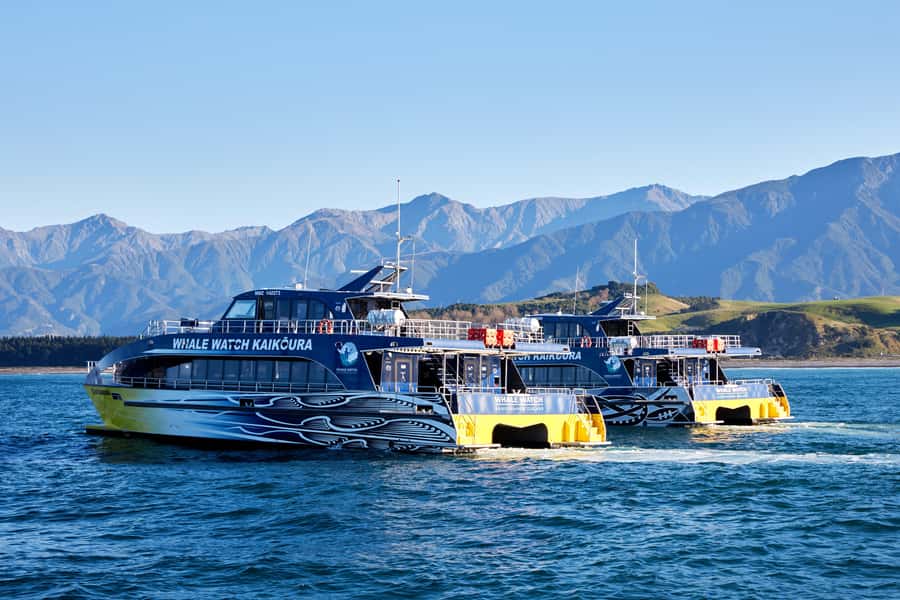
I recommend the Kaikoura whale watching cruise for most visitors who have room in their itinerary and understand that wildlife follows its own timetable. The strongest reasons are the chance to see sperm whales in a natural setting, the skilled crew, the spacious catamaran, and the wide range of possible birds and marine animals.
Book it for the whole experience, not just the whale photograph. If the sea is kind, you may see a sperm whale, hundreds of dolphins, seals, and albatross against the Kaikoura mountains. If conditions are rough, the crew will work hard, but you may need to spend time indoors or accept a more distant sighting. That honest trade-off is part of the adventure.
FAQ
How long does the Kaikoura whale watching experience take?
Allow 210 minutes, or about 3 hours 15 minutes, for check-in, the safety briefing, bus transfers, and the cruise. Time on the water is just over two hours.
How much does the cruise cost?
The listed price is $104 per person.
What whale is the cruise mainly designed to find?
The main target is the giant sperm whale, the world’s largest toothed predator.
Can I see dolphins and seals too?
Yes. The cruise looks for other wildlife, including dolphins, fur seals, and seabirds. Sightings depend on the conditions and the animals present that day.
Are wandering albatross included?
Wandering albatross are among the birds you might see, but no wildlife sighting is guaranteed.
Where does the cruise begin?
You meet at the Whale Watch Kaikōura office. From there, a bus transfer takes you to the boat.
What happens if the weather is poor?
The cruise operates only in favorable weather conditions. The operator confirms the exact tour time by email and may change the time because of weather or availability.
Is the cruise suitable for children?
Children must be at least three years old. The minimum age can still depend on sea and weather conditions at check-in. Children under three are not suitable.
What should I do if I get seasick?
Take precautions before arriving. Motion-sickness tablets are available for purchase at the office, and the crew can help passengers who feel unwell.
Is the boat wheelchair accessible?
Yes, the activity is listed as wheelchair accessible. Smoking is not allowed, and food and drinks are not included.
Just added around New Zealand
- Queenstown: Milford Sound Small-Group Tour w Cruise & Lunch★ 4.9 · 523 reviews
- Queenstown: Lake Whakatipu Boat Trip★ 4.7 · 633 reviews
- Queenstown: Milford Sound Flight and Cruise★ 4.9 · 283 reviews
- Queenstown: Queenstown Lake Cruise and Walter Peak Farm Tour★ 4.8 · 950 reviews
- Queenstown: Lake Wakatipu Scenic Cruise★ 4.7 · 264 reviews
- Queen Charlotte Track: Cruise & Self-Guided Hike from Picton★ 4.8 · 383 reviews
- Queen Charlotte Sound Mail Boat Cruise from Picton★ 4.7 · 541 reviews
- Paihia: Glass Bottom Boat Tour to the Hole in the Rock★ 4.7 · 319 reviews
Whale Watching, compared.
Eco-Yacht Whale and Dolphin Watching and Swimming
Read our review →
Whale & Dolphin Eco-Cruise with Snacks & Drinks
Read our review →
Dolphin & Whale Watching Cruise with Swim Stop
Read our review →Browse the lists this tour appears in